
Independent AMSOIL Dealer Free Shipping $100+
Havasu Synthetics - Independent AMSOIL Dealer

America's Trusted AMSOIL Experts

AMSOIL Dirt Bike Oil for Lake Havasu and the Desert Southwest

Pick the right AMSOIL synthetic dirt bike oil for Lake Havasu heat, fine talcum dust, and dual-sport water crossings. 10W-40, 10W-50, 10W-60, and separate-sump transmission fluid.

Shop the full AMSOIL Dirt Bike Oil lineup

Why dirt bike oil is different out here

Generic four-stroke oil recommendations assume 70 to 80 degree days, paved staging areas, and air filters that stay reasonably clean. Lake Havasu in the summer is none of that. Ambient air at the truck can sit at 110 to 115 degrees by 10 AM, and that is before you add engine heat soak on a high-compression 450 ridden hard. Talcum-grade desert dust gets through anything but a perfectly serviced filter, and dual-sport riders in this region cross the occasional wash without much warning.

Pick the oil for the conditions you actually ride in, not the conditions the manual was written for. The grades below are the ones worth carrying for Havasu and Mohave County riding.

Pick your grade

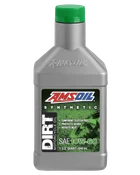
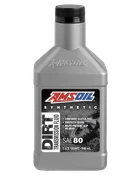
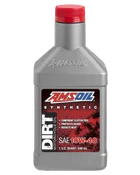
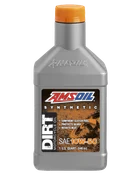
For Honda CRF, Yamaha YZF, Kawasaki KX-F, and Suzuki RM-Z four-strokes the engine and transmission share a common sump — one oil does both jobs. For KTM, Husqvarna, Husaberg, and Beta competition four-strokes the gearbox is separate — the engine uses the same grades below, the gearbox uses the Synthetic Dirt Bike Transmission Fluid (DBTF) further down this page.

Match the grade to your bike’s manual and the riding you actually do. The variant blocks below give the practical use cases for each one.

About the separate-sump transmission fluid

If your bike is a modern KTM, Husqvarna, Husaberg, or Beta four-stroke, the gearbox runs its own dedicated oil — separate fill plug, separate drain. Putting engine oil in the gearbox or gearbox fluid in the engine is a common mistake on these platforms. Use the engine oil (10W-40, 10W-50, or 10W-60) in the engine and the Synthetic Dirt Bike Transmission Fluid (DBTF) in the gearbox. The trans fluid is wet-clutch compatible and built for the gear-tooth pressures of a dirt bike trans, which is a different job than what engine oil is doing.

Adventure and dual-sport riders

If you are riding an adventure or dual-sport in the desert Southwest — KLR, DR, KLX, CRF-L, KTM or Husqvarna enduro, Africa Twin, T7, or a bigger ADV twin — the Adventure & Dual Sport Guide collects the rest of our maintenance documentation for this region: oil intervals when you actually ride in 110-degree heat, wet-clutch fluid notes, fuel-additive use at remote stations, and water-crossing recovery.
Frequently Asked Questions

Which AMSOIL dirt bike oil should I run in Lake Havasu summer?

Start with the grade your owner manual specifies and step up to the next-heavier hot grade if you ride hard in sustained heat. For most trail and dual-sport four-strokes that is 10W-40 (DB40). For high-output 450s ridden race-pace in 100F+ heat that is 10W-50 (DB50). For 500-class desert bikes that is 10W-60 (DB60). If you are not sure, default to what the manual says — synthetic dirt bike oil already gives you margin in the heat that conventional oil does not.

I ride a KTM 350 EXC-F. Do I need both an engine oil and a transmission fluid?

Yes. KTM four-strokes (and Husqvarna, Husaberg, and most modern competition four-strokes) have a separate-sump gearbox. The engine runs one oil, the transmission runs another. Use 10W-40, 10W-50, or 10W-60 in the engine per your manual, and Synthetic Dirt Bike Transmission Fluid (DBTF) in the gearbox. Japanese four-strokes (Honda CRF, Yamaha YZF, Kawasaki KX-F, Suzuki RM-Z) share a common sump and only need the engine oil.

Does the ethanol pump gas from remote Mohave County stations hurt the oil?

Ethanol does not directly contaminate the oil if the engine is healthy and the rings seal. The real risk is fuel sitting unused — ethanol pulls moisture, which ends up as acidic blow-by in the crankcase between rides. If your bike sits for weeks between sessions in Havasu summer, run fresh fuel, stabilize the tank, and treat oil change intervals as time-based as much as hour-based.

I just crossed a wash and got water in the airbox. Do I need an immediate oil change?

If water made it past the air filter and into the intake, yes — drop the oil before the next ride and check the filter. Water in oil emulsifies it, which destroys film strength under load. This is more of a dual-sport risk in our area than a pure-trail risk. If you ride water crossings regularly, plan tighter oil-change intervals in the summer when you are also fighting heat-driven oxidation.

How often should I change dirt bike oil in Havasu heat?

Follow the manufacturer interval as a floor, not a ceiling. Two-stroke premix is consumed continuously and is not a concern. For four-stroke engine oil, plan tighter than the manual if you are riding sustained high RPM in 100F+ heat, doing repeat moto laps, or letting the bike sit for weeks between rides in summer. The owner manual interval was written for moderate conditions — desert summer is not moderate.

Will running AMSOIL void my Honda, Yamaha, Kawasaki, Suzuki, KTM, or Husqvarna warranty?

No. AMSOIL synthetic lubricants are covered by the AMSOIL Limited Warranty and do not void OEM warranties. Manufacturers cannot require you to use their branded oil to maintain warranty coverage as long as the oil meets the specifications in the owner manual.

Ready to order?

Every link on this page sends you to AMSOIL.com with our dealer number attached, so you get the correct pricing and Havasu Synthetics gets credit for the order. Preferred Customer registration saves up to 25% on every future order — ask us if you order regularly.

See AMSOIL Dirt Bike Oil at AMSOIL.com
Havasu Synthetics is an authorized AMSOIL dealer. Product links on this page earn us a commission at no extra cost to you. Full disclosure